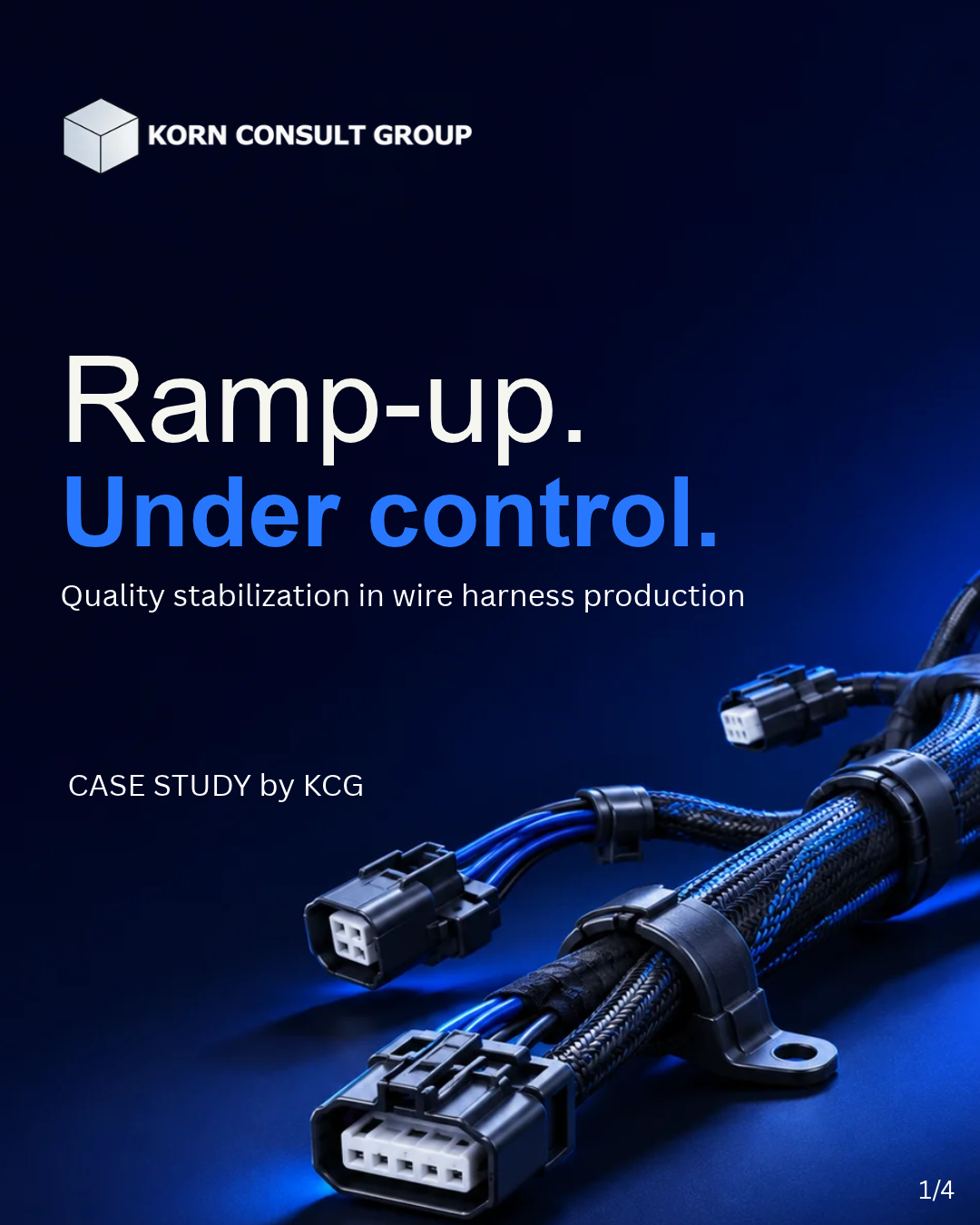
A production launch tests more than capacity. It tests how quickly an organization can recognize a quality problem, contain it, understand its cause, and prevent it from reaching the customer again.
In wire harness production, that challenge becomes particularly demanding as volumes increase. Routing errors, assembly inconsistencies, and rework can put pressure on both delivery performance and customer confidence.
KORN CONSULT GROUP (KCG) supported a Tier 1 customer through this critical phase, with a clear objective: improve delivered quality while establishing routines that the production and quality teams could sustain.
Our focus was practical from the start. We needed to strengthen containment, reduce rework and first-time quality (FTQ) losses, and make corrective action management part of daily operations.
Making the problems visible
We began with a detailed analysis of customer complaints, containment findings, rework data, and FTQ losses. Reviewing these sources together helped us identify recurring defect patterns and prioritize the issues with the greatest impact.
Pareto analysis established where to concentrate our efforts. Root cause analysis then helped move the discussion beyond the defect itself to the conditions allowing it to occur.
From a consultant’s perspective, this is a decisive step. A team can spend considerable time reacting to individual findings while the same underlying problem continues to generate losses. Improvement depends on connecting those findings and turning them into specific actions.
Rebuilding daily quality discipline
We re-established daily QRQC routines and structured escalation processes to improve reaction speed and accountability.
Daily ZNA complaint analysis reached 100% coverage, with corrective actions defined within the target timing. QRQC execution compliance also reached nearly 100%.
These routines gave teams a regular opportunity to review problems, assign responsibility, and follow up on implementation. KPI monitoring and effectiveness reviews helped keep attention on whether corrective actions were working.
Containment processes were strengthened alongside this work. We improved data collection and feedback between production, rework, and quality teams so that findings could inform action at the relevant workstations.
Turning analysis into changes on the shop floor
The project also addressed the physical conditions affecting assembly quality. Technical improvements included changes to assembly boards, routing guidance, jigs, holders, and workstation ergonomics.
These changes supported operators in performing critical tasks more consistently. They also connected the corrective action process to the place where quality is created: the workstation.
The results showed measurable progress:
- Containment defects fell from 5.8 per harness to 4.1 in 6 weeks outperforming the planned reduction curve.
- Wrong wire routing decreased from 5.98% to 0.60% in 7 weeks, before subsequent ramp-up-related fluctuations.
- Overall rework performance improved, with an approximately 3% reduction during the project period.
The routing fluctuations reinforced an important lesson: an early improvement needs continued attention as production conditions change. Daily follow-up, reliable feedback, and effectiveness checks remain essential throughout the ramp-up.
For us at KORN CONSULT GROUP (KCG), successful launch support means achieving measurable improvements while helping teams build the discipline to maintain them. Stronger containment provides immediate protection. Better workstation conditions and consistent corrective action management help reduce recurring losses.
Is your ramp-up putting customer quality and delivery performance under pressure? Contact KORN CONSULT GROUP to discuss your launch challenges and define a focused stabilization plan. Turn recurring defects into targeted action and build customer confidence with measurable results.